
Traffic Warrants in Dallas County
Every Dallas County traffic citation lists a court and an appearance date, and the person cited must appear or resolve the case before that day passes. The Dallas County traffic page warns that failing to appear or pay can trigger, without any prior notice, an alias arrest warrant plus an ALEA license suspension. In Alabama, "alias warrant of arrest" is simply the failure-to-appear warrant. Which court holds the case depends on who wrote the ticket. State-trooper and county-deputy citations generally route through the Circuit Clerk to Dallas County District Court, while Selma police and other city citations go to Selma Municipal Court. That split decides where you confirm a warrant, what payment or appearance is allowed, and which judge can withdraw the order. No payment portal can answer for the issuing court. The Dallas County warrant-issuance page also lays out how the process starts: a magistrate and a probable-cause review come first, before any warrant carries court authority in Dallas County.
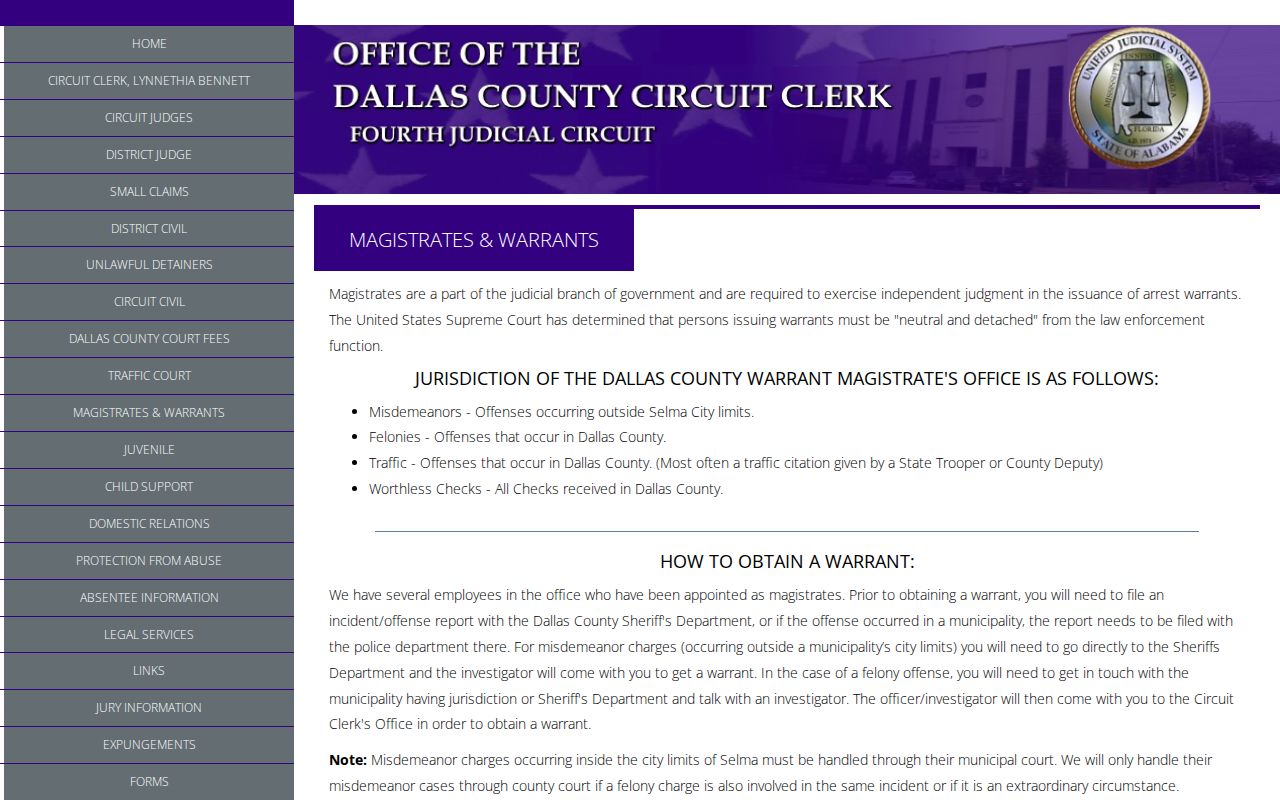
The official Dallas County traffic page separates the court action that creates a warrant from the payment and clearance steps that follow. That distinction matters for any traffic case.
Dallas Traffic Court Alias-Warrant Warning
Dallas County posts its alias-warrant warning right beside the court-date and payment instructions, so the risk is hard to miss. Not every ticket can be paid away online. Some charges must go before a judge first. DUI, driving while suspended, and reckless driving are among them, and fines for those matters are not assessed until an appearance happens. The official Dallas County traffic source shows these limits in the same court-record context, which is worth reading in full before assuming a quick online payment will settle a Dallas County case.
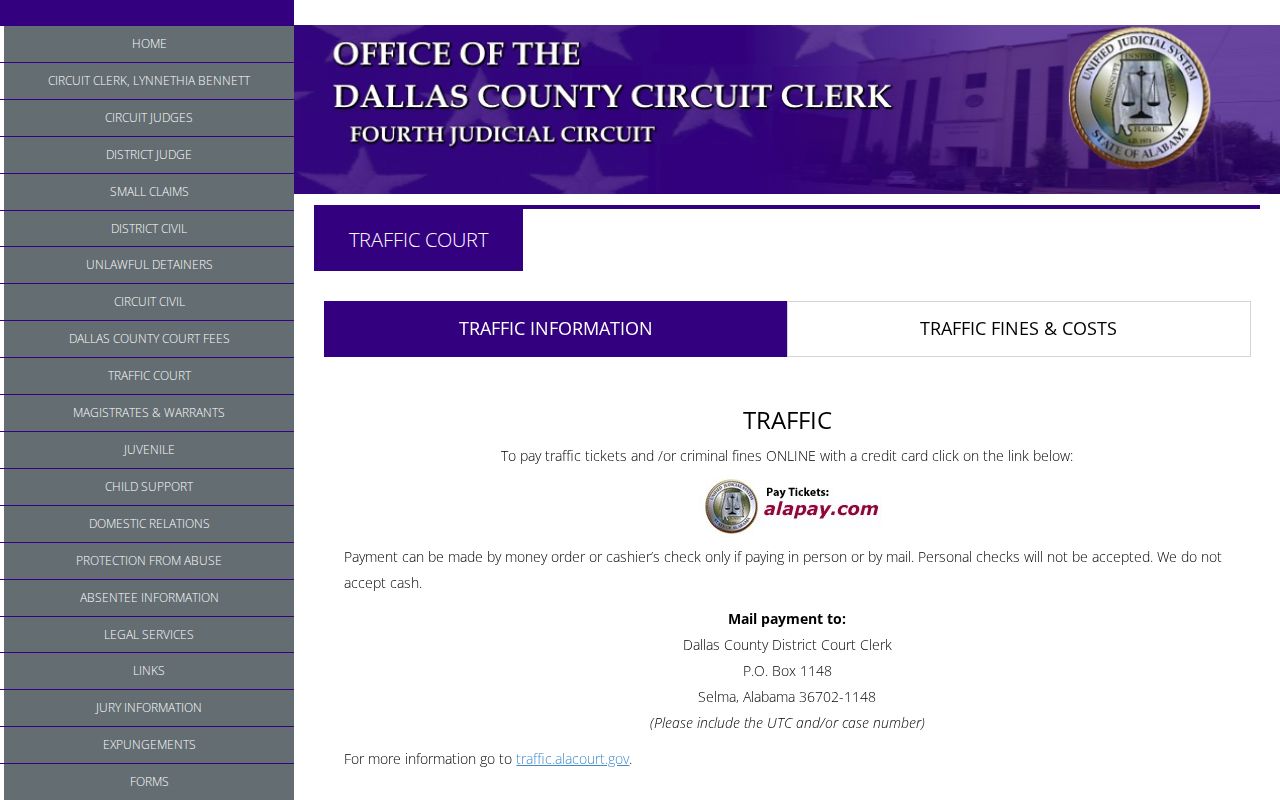
The image ties a missed or unpaid citation to the court action that can follow. It shows no driving history and no public list of people.
How to Check for a Traffic Warrant
Gather the citation number, the court name, and the date first. Alabama's Online Traffic Resolution system then accepts a ticket or case number plus the person's birth month and year. Its options depend on the case at hand. Keep in mind it is a traffic resolution system, not a Dallas County arrest-warrant search.
- Read the ticket and identify Dallas County District Court or Selma Municipal Court.
- Use Alabama OTR or the Traffic Service Center for eligible citation information.
- Call the Dallas County Circuit Clerk at (334) 874-2523, or Selma Municipal Court at (334) 876-1299, when the date passed or online options do not fit.
- Ask the clerk whether the alias warrant is active and what appearance, payment, bond, reset, or judge order is required.
- Visit the clerk only after confirming current hours, acceptable payment, and whether counsel should arrange the appearance.
A Dallas County arrest warrant may still need the Sheriff's involvement if it must be served. But recall stays with the issuing court alone.
Dallas Traffic Warrant Search Fields
Alabama OTR works from narrow case identifiers, not a public name search. So a missing result may mean little. The ticket might simply not be in the system yet. The Traffic Service Center says entry can take up to ten business days. Once that window passes, call the Dallas County clerk rather than treating the absence as proof that no case or warrant exists.
| Field | Type | When Used | Dallas Limitation |
|---|---|---|---|
| Ticket or case number | Text | Required for OTR entry | Must match the citation |
| Birth month and year | Two selectors | Required for identity match | Not a general name search |
| County | Map or selector | Local court route | Select Dallas County |
| Active Warrant | Conditional checkbox | Past-date path | Does not itself recall the warrant |
| Resolution option | Case-based control | Eligible cases only | New-date option is not listed for Dallas |
What a Traffic Warrant Shows
Dallas County publishes no public traffic-warrant result card. A citation, an Alabama failure-to-appear notice, and the C-65a alias-warrant form together cover the practical fields a clerk can confirm. Read the number and court first, because they control routing and keep a payment from going to the wrong venue.
| Ticket or case number | The UTC or court identifier, shown here only as UTC-CASE-NUMBER. |
|---|---|
| Charge | The cited offense and whether an appearance is mandatory. |
| Issuing court | Dallas County District Court or the named municipal court. |
| Dates | The original setting, missed date, issue date, and any new setting. |
| Amount or bond | The court amount when set; no county warrant bond schedule is published. |
| Status | Active, served, withdrawn, paid, or another court term that needs confirmation. |
Guessing from a status label beats asking, but only one is reliable. Ask the clerk. A "paid" mark, after all, may not prove an alias warrant was withdrawn.
Dallas Users Must Call for New Dates
The statewide past-date workflow can display an active-warrant option and a reason field for requesting a new date. Here is the catch: the official instructions say the online new-court-date option is open only in Montgomery County. A Dallas County user who submits the form should not assume the case was reset. Call instead. Give the Circuit Clerk the UTC or case number for the Dallas County case. The county page states plainly that the clerk cannot grant a continuance; a continuance request must go in writing to the judge and include the case number. Once a warrant exists, ask the court directly whether it wants an appearance, payment, bond, or some other judicial action before it will recall the warrant.
Key point: An OTR control visible statewide does not establish that Dallas County offers that option for the case.
Paying or Lifting a Traffic Warrant
Confirm eligibility and exact status before any money moves. Dallas County lists a $183.50 traffic court-cost baseline plus offense-specific totals, and those amounts can rise after the court date, so verify with the clerk first. For mail and in-person payment, the local page accepts a money order or cashier's check only. No personal checks and no cash. Credit or debit cards are accepted in the office, and the official AOC-linked route handles eligible online card payments.
- Locate the UTC or case number and court date.
- Ask whether payment is allowed or an appearance is mandatory.
- Use the court-approved method and keep the confirmation number or receipt.
- Ask what action withdraws the alias warrant and whether a judge must act.
- Obtain a clearance notice and confirm any required ALEA update.
Warning: Online payment alone may not withdraw an active Dallas County traffic warrant or complete an ALEA license-clearance step.
Dallas County Payment Versus Trial Choice
Think before you mail that check. Paying a traffic ticket in Alabama is more than a data update: the state's traffic guidance warns that paying an eligible citation can operate as a guilty plea and a waiver of trial rights. It can also defeat an application for defensive driving. So dispute the charge first. Learn the court's procedure before any money moves. Dallas County takes mail payments at the District Court Clerk, P.O. Box 1148, Selma, AL 36702-1148, with the UTC or case number included. Prefer the phone? The state payment line is 1-877-252-7294. The Traffic Service Center call center is 1-866-954-9399. Those channels cover eligible court payments only. Neither guarantees recall of an alias warrant. And do not skip court over money; Selma Municipal Court publishes a payment-plan request process, while Dallas County publishes no matching traffic warrant payment plan.
Traffic Warrant vs FTA and License Holds
One missed Dallas County traffic date sets off three linked but separate events. Failure to appear is the missed obligation itself. The alias warrant is the court's arrest order. ALEA suspension is administrative, triggered by notice from the court system, and fixing one record does not always update the others at once.
| Mechanism | Trigger | Effect |
|---|---|---|
| Failure to appear | Missed setting or failure to resolve | Creates a court default and may add a late fee |
| Alias traffic warrant | Court action after nonappearance or nonpayment | Authorizes arrest until served or withdrawn |
| ALEA suspension | Court reports unresolved traffic noncompliance | Affects the state license record until clearance |
Dallas County's court sends ALEA a clearance notice once its requirements are met. If the suspension still shows, call the Driver License Division at 334-242-4400 and follow the court's delivery instructions.
Dallas and Selma Traffic Warrants Differ
Dallas County District Court takes state-trooper and county-deputy traffic matters. Selma Municipal Court handles city police tickets, code enforcement, and business-license citations. According to Selma, two missed court settings after notice produce a warrant. The city also publishes a payment-plan option, and it accepts only money orders for the office process it lists. Selma's own pages conflict on warrant hours. One says Monday through Wednesday, 9:00 a.m. to 2:00 p.m. Another lists Monday, Wednesday, and Friday at the same times. Call (334) 876-1299 before you travel there. Dallas County traffic cases are different, so ask the Circuit Clerk about those instead. The word warrant does not merge the two files. After any payment, appearance, or reset, get written proof from the issuing court, then confirm the alias warrant was withdrawn and ALEA received any clearance it needs.